Direct analysis of small blood volumes
Rodent models are frequently used in clinical research, as they allow manipulations and interventions that are not possible in human studies. However, the limited blood volume available for sampling poses a challenge, as only small volumes can be collected without inducing hypovolemic stress in the animal.
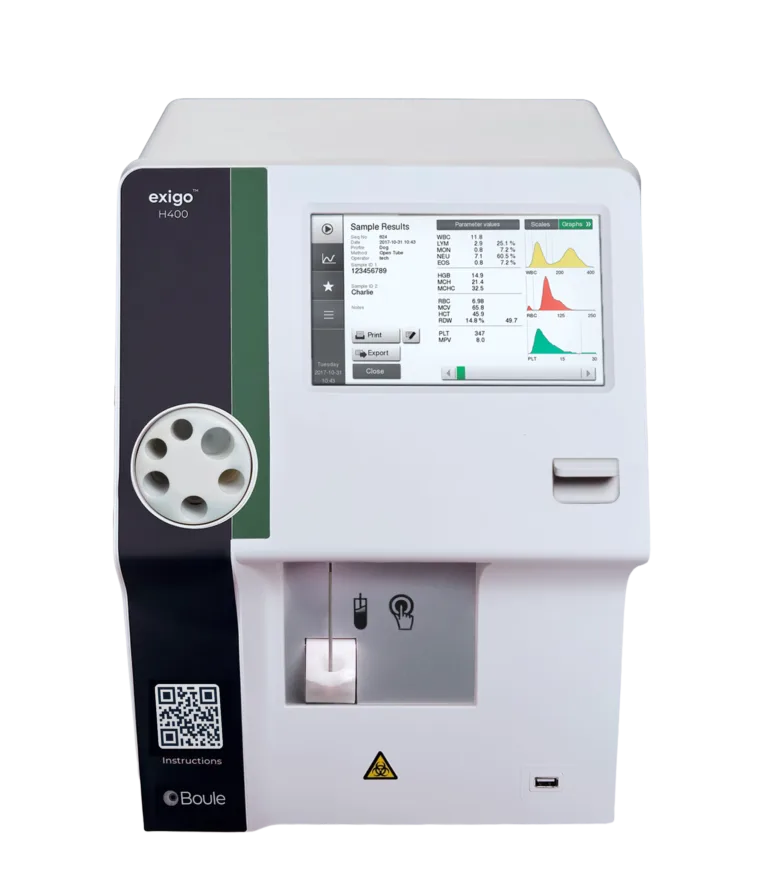
The Boule micropipette adapter (MPA) method allows small blood volumes to be collected and directly analyzed in the Exigo H400 hematology analyzer (Fig. 1). A 20 µL blood sample is sufficient to obtain results from a complete blood count (CBC) within approximately one minute.

Fig 1. The MPA method of Exigo H400 allows direct analysis of small blood volumes collected by tail vein sampling of rats or mice. No excess blood collection, no vacuum tubes, or mixing required.
Studies of rodent models using Exigo H400 veterinary hematology analyzer
Rat model of colitis
Ulcerative colitis is an inflammatory bowel disease (IBD) characterized by swelling and ulcers of the digestive tract. Among the complications of IBD is malabsorption of vitamins and micronutrients, which can ultimately lead to anemia (1). Iron deficiency is a known precursor of anemia and one of the most common systemic complications associated with IBD (2, 3).
In cases of defective hemoglobin synthesis due to iron deficiency, red blood cells (RBCs) become unevenly small (microcytic). Anisocytosis, reflected by increased red blood cell distribution width (RDW), can be an early laboratory indicator of anemia.
Adamkova and colleagues at the Pavol Jozef Safarik University in Košice, Slovakia investigated the suitability of a dextran sulphate sodium (DSS)-induced colitis rat model to monitor microbial changes during acute colitis and evaluate microbiome-based therapies (4).
Basic hematological parameters were determined using blood collected from the lateral tail vein into Boule EDTA micropipettes and analyzed with the Exigo H400 hematological analyzer. The findings suggest that the DSS-induced colitis rat model may provide insight into hematological changes associated with IBD-related iron deficiency anemia.
Mouse model of hyperinflammation
Hyperinflammation, or severe inflammation, occurs in various disease conditions (5, 6) and is commonly associated with anemia and thrombocytopenia (7).
Malka and coworkers at the Ben-Gurion University of the Negev, Be’er Sheva, Israel investigated the anti-inflammatory properties of small molecules and their potential role in modulating severe inflammation in a lipopolysaccharide (LPS)-induced mouse model (8).
Blood samples for hematology analysis were collected from mouse tails using Boule EDTA micropipettes and analyzed with the Exigo H400 hematological analyzer. The results showed that certain small-molecule metabolites were associated with reduced hyperinflammatory responses, as well as lower levels of anemia and thrombocytopenia in this model.
References
1. Harbord et al. The First European Evidence-based Consensus on Extra-intestinal Manifestations in Inflammatory Bowel Disease. J Crohns Colitis 10, 239–254 (2015).
2. Niepel et al. Practical guidance for the management of iron deficiency in patients with inflammatory bowel disease. Therap Adv Gastroenterol https://doi.org/10.1177/17562848187690 (2018)
3. González et al. Prevalence of iron deficiency without anaemia in inflammatory bowel disease and impact on health-related quality of life. Gastroenterol Hepatol 41, 22–29 (2018).
4. Adamkova et al. Dextran Sulphate Sodium Acute Colitis Rat Model: A Suitable Tool for Advancing Our Understanding of Immune and Microbial Mechanisms in the Pathogenesis of Inflammatory Bowel Disease. Vet Sci 9, 238 https://doi.org/10.3390/vetsci9050238 (2022).
5. Hotchkiss et al. Sepsis and septic shock Richard. Physiol Behav 176, 139–148 (2017)
6. Furman et al. Chronic inflammation in the etiology of disease across the life span. Nat Med 25, 1822–1832 (2019).
7. Canny et al. Immune Mechanisms in Inflammatory Anemia. Annu Rev Immunol 41, 405–42 (2023).
8. Malka et al. Tryptophol Acetate and Tyrosol Acetate, Small-Molecule Metabolites Identified in a Probiotic Mixture, Inhibit Hyperinflammation. J Innate Immun 15, 531–547 (2023).