Low platelet (PLT) count is a side-effect of chemotherapy
Chemotherapy-induced thrombocytopenia (CIT) is a common complication in cancer patients undergoing chemotherapy treatment. As platelets (PLTs) play a key role in blood clotting, a reduced platelet count (thrombocytopenia) may increase the risk of bleeding following injury or medical procedures. According to literature, a normal reference interval for PLTs in adults is about 160–390 ×109/L (1).

Overview of hematology parameters
Kuter and colleagues at Harvard Medical School, Boston, MA, USA define chemotherapy-induced thrombocytopenia as a platelet count below 100 × 10⁹/L, with severity categorized as follows (2):
Grade 1: 75 × 10⁹/L to < 100 × 10⁹/L
Grade 2: 50 × 10⁹/L to < 75 × 10⁹/L
Grade 3: 25 × 10⁹/L to < 50 × 10⁹/L
Grade 4: < 25 × 10⁹/L
Platelet counts below 50 × 10⁹/L may complicate surgical procedures, while spontaneous bleeding can occur at platelet levels below 10 × 10⁹/L (2). For this reason, cancer patients receiving chemotherapy are often monitored regularly for platelet count to support clinical risk assessment.
Platelet count determination in the low range
When a critically low PLT count is detected, Boule hematology analyzers include a PLT extended counting time functionality designed to improve the accuracy of the result. When enabled, the platelet counting time is extended, allowing the analyzer to count approximately three times more platelets than in standard mode, with the aim of improving reliability in the critically low PLT range.
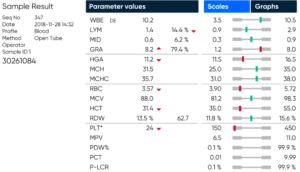
If PLT extended counting is enabled and a low platelet count is detected during analysis, the extended counting phase is displayed and indicated by an asterisk (*) next to the PLT parameter on the result screen, printouts, and exported reports.
Reference
1. Mayo Clinic Laboratories. Rochester Interpretive Handbook (2021).
2. Kuter, D.J. Treatment of chemotherapy-induced thrombocytopenia in patients with non-hematologic malignancies. Haematologica 107, 1243–1263 (2022).