
Use of Red Blood Cell Indices in Identifying Thalassemia
Red blood cell (RBC) indices can be useful in identifying thalassemia, and several indices have been proposed to help differentiate thalassemia from iron deficiency anemia (IDA).
Differentiating Thalassemia from Iron Deficiency Anemia
Iron deficiency is the most common cause of anemia and occurs when the body’s intake or storage of iron is insufficient to support normal erythrocyte production (1, 2). Thalassemia is another cause of anemia, with approximately 50% of global cases reported in Southeast Asia (3). In Pakistan, thalassemia is the most common inherited disorder, with an estimated prevalence of 5–7% (3, 4).
Both iron deficiency anemia (IDA) and thalassemia typically present with microcytosis and hypochromia, resulting in reduced hemoglobin concentration. However, while IDA is a nutritional disorder that can often be managed with iron supplementation, thalassemia is an inherited condition for which blood transfusion remains a key component of management (4, 5).
Accurate differentiation between IDA and thalassemia is therefore important, as hemoglobin levels in thalassemia patients will not improve with iron supplementation (6). In combination with biochemical tests such as serum iron measurements, RBC indices can provide useful screening information (3, 6).
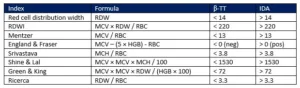
Several formulas incorporating RBC indices have been proposed to distinguish thalassemia from IDA (Table 1). Among these, the RDW index (RDWI) and the Mentzer index have been reported to yield higher diagnostic accuracy (3, 6).
Cell Discrimination and Accuracy of RBC Indices
Accurate RBC counting, cell sizing, and hemoglobin determination are essential for reliable calculation of RBC indices used in anemia investigations. Many older hematology analyzers apply a fixed discriminator at 30 fL to separate RBCs from platelets (PLTs). However, high platelet counts may interfere with mean cell volume (MCV) measurements.
Similarly, microcytic RBCs with very low MCV values may be misclassified as platelets, leading to falsely elevated platelet counts, as the minimum between RBC and PLT histograms may not be clearly distinguishable below the fixed discriminator threshold.
These effects can be reduced using a floating discriminator technique, which dynamically determines the optimal separation point between cell populations. Boule’s 3-part hematology analyzers apply a discriminator that floats between 10 and 28 fL, helping to prevent microcytic RBCs from being misclassified as platelets (Fig. 1).
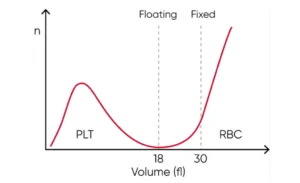
Fig. 1. Floating discriminator technique helps prevent microcytic RBCs from being incorrectly counted as platelets and minimizes platelet interference with RBC measurements.
Learn more
Read more from the white paper Clinical utility of red blood cell indices in anemia investigations
References
- WHO: Anaemia. who.int/data/nutrition/nlis/info/anaemia (accessed 2023-08-24).
- Miller, J.L. Iron Deficiency Anemia: A Common and Curable Disease. Cold Spring Harb Perspect Med 3, a011866 (2013).
- Niazi et al. Usefulness of red blood cell indices in differentiation of microcytic hypochromic anemias. Gomal J Med Sci 8, 125–129 (2010).
- Khaliq, S. Thalassemia in Pakistan. Hemoglobin 46, 12-14 (2022).
- Li et al. The Efficacy and Safety of Vitamin C for Iron Supplementation in Adult Patients With Iron Deficiency Anemia: A Randomized Clinical Trial. JAMA Netw Open 3, e2023644 (2020).
- Jameel et al. Differentiation of beta thalassemia trait from iron deficiency anemia by hematological indices. Pak J Med Sci 33, 665–669 (2017).